
Comparing SEO companies for small business starts with the work your business needs first, what can wait and who implements the changes. A suitable provider should explain those priorities within your budget and available time. Define your offer, operating area and inquiry process before comparing packages. This guide is published by RankProSEO and helps you compare providers, including us, against a consistent brief.
SEO Companies for Small Business: Start With a Clear Brief
Describe your main service, ideal customer, genuine service area and the work you want more of. Include the website, relevant profiles, current lead sources and the people available to approve or implement changes. Record any important constraints, such as a redesign already planned or limited capacity to answer calls. This gives an SEO provider enough context to discuss priorities without assuming that every small business needs the same package.
Identify the foundations that need attention
An established business may need clearer service pages or better local information. A new business may need essential pages, technical launch checks and a working inquiry flow. Ask how the provider will assess the starting point and choose the first tasks. For example, producing many blog posts may be a poor first use of the budget if the main service page is incomplete or the contact form does not work. The explanation should connect each priority with the business problem.
Choose between a project, consulting and ongoing work
A defined project can be useful when the deliverable is clear, such as a page map or a technical investigation. Consulting can help when you have a team but need direction. Ongoing delivery may fit a sustained program of implementation, content and review. Ask what the business must supply in each model and how the next phase is decided. A retainer should not be the automatic answer when the initial prerequisites are still missing.
Make the budget comparison meaningful
Ask each provider to separate the work included, exclusions, implementation responsibilities and any tool or third-party costs. Explain the budget range you can sustain and request a scope that fits it. Compare the tradeoffs explicitly: fewer services may be appropriate if the priority work is clear. A cheap headline price is difficult to assess when the proposal does not say who will implement the recommendations or how completion is checked.
Check who will do the work
Find out who researches the site, writes content, makes technical changes and reviews the result. Ask how the provider will learn your services and obtain accurate business information. Review relevant examples and their context. A provider does not need to claim that it has served every industry, but it should explain how the team can handle the proposed scope. Clearly labeled demonstrations can show a method; they are different from verified client case studies.
Agree on ownership and a manageable workflow
The business should understand who controls the website, profiles, analytics and content. Define access, approval steps and what will be handed over when the project ends. Keep the working process realistic: one person may need to approve copy, supply images and review inquiries alongside running the business. A focused task list with owners and acceptance checks makes it easier to keep work moving without losing visibility into the account.
Measure the inquiries your business can use
Agree what a qualified lead means before evaluating reports. For a home service company, service type and job location may be essential. For a professional practice, the requested service and client fit may matter more. Review calls and forms alongside the work completed and available search data. A report should help explain what to improve next; it should not treat every visit or inquiry as equally valuable.
Your proposal checklist
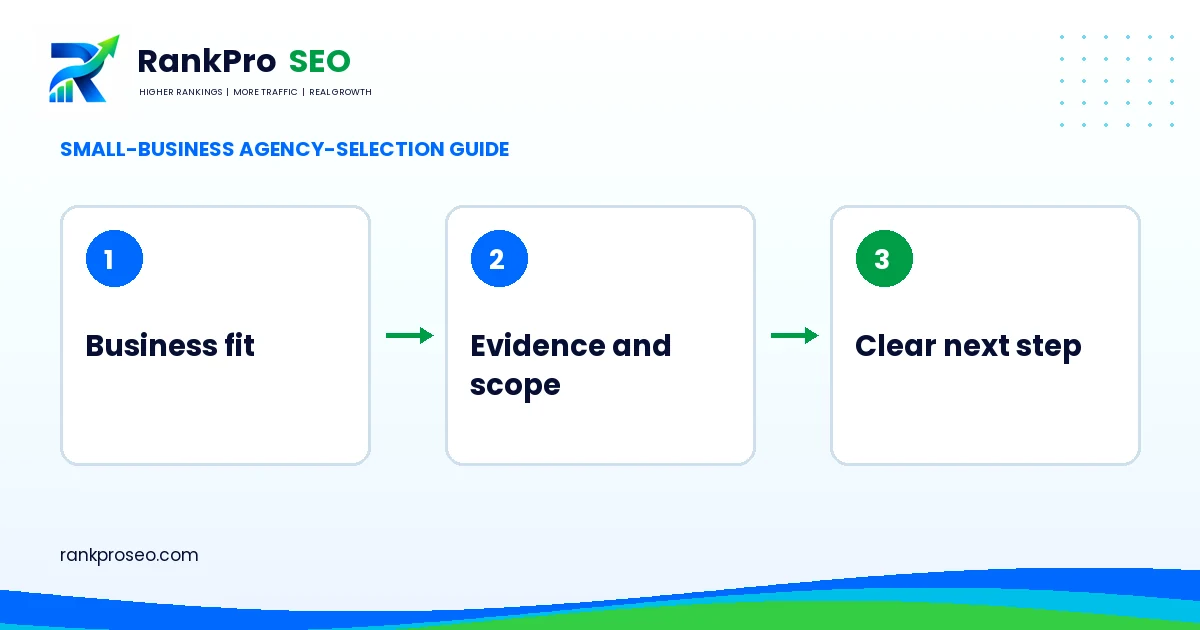
Before choosing, confirm: the business goal; the first priorities; deliverables and exclusions; the people doing the work; implementation ownership; account and content ownership; reporting method; review points; handover terms. Mark each item as clear, unanswered or unsuitable and record the supporting detail. Resolve important unanswered items directly with the provider. This approach makes different proposals easier to compare without assuming that the longest task list is the strongest offer.
Small business agency questions
Should I choose the cheapest SEO company?
Compare the useful scope and delivery responsibilities alongside price.
Do I need articles every month?
Publish when there is a distinct useful question and a clear connection to your services.
Can the provider guarantee leads?
No. Demand, the offer, competition and inquiry handling also affect results.
Can I begin with a project?
Yes, when a defined scope is the useful first step and both parties understand what it includes.
What if my budget cannot cover everything?
Ask for priorities and explicit tradeoffs rather than an unrealistic promise to do everything.
Build a focused SEO brief
Share your website, main service, target customers and budget range. Explore small-business SEO support and ask for a scope that makes the first priorities clear.