
The best SEO company in New York for your business is one whose scope, experience and delivery model fit the problem you need solved. A local contractor, a professional practice and a software business can need different work. Define the customer you want to reach, the services you want to grow and who can implement changes, then compare providers against the same brief. This guide is published by RankProSEO, an SEO service provider, and offers selection criteria rather than an independent agency ranking.
Best SEO Company in New York: Compare the Work, Not the Claim
Write down what a useful inquiry looks like: service, location, customer type and any basic project requirements. Review the website’s starting point and the team available to handle leads. A request to rank for more keywords is difficult to assess without that context. A clearer brief might ask for better discovery of a core service in a genuine operating area, with suitable quote requests as the business outcome. Search volume helps prioritize opportunities, but it does not tell you whether an inquiry fits the business.
2. Check whether the service model matches the problem
Local SEO typically connects business information, profiles, service pages and local discovery. Consulting can provide direction for an existing team. Technical work may investigate crawling, indexing or template behavior. Content work can improve service explanations and supporting resources. Ask the provider which part of the problem it will own and why that scope fits. A broad agency can offer several disciplines, but the proposal still needs to name the people and responsibilities involved in your project.
3. Compare written scope, not just the monthly price
Use the same questions for each proposal. What is reviewed at the start? Which pages or profiles are included? Who writes, approves and implements changes? How are technical tasks handed to a developer? What is excluded? Which third-party costs are separate? What happens to accounts and content at the end? A lower price may reflect a smaller useful scope, or it may omit work you need. Compare the deliverables and dependencies before deciding which interpretation is correct.
4. Ask for evidence you can interpret
A useful case explains the business context, starting point, work completed, time period and measurement method. It should identify important limitations, such as other marketing activity or a redesign occurring at the same time. A screenshot of increased traffic can be informative without proving suitable leads or revenue. Ask how the example relates to your situation and which team members performed the work. Newer providers can show their method and clearly labeled demonstrations; they should not present those as completed client results.
5. Understand implementation and account ownership
An audit is only useful when someone can act on the findings. Ask whether the provider implements changes directly, gives specifications to your team or reviews work after release. Agree who can approve website edits and how access is granted. Keep business accounts under appropriate business ownership and document the handover process. For a practical example, a technical finding should identify the affected page or template, intended behavior, task owner and verification step. That is more useful than an unexplained export of warnings.
6. Make reporting answer a business question
Ask to see a sample report and what decisions it supports. Rankings, impressions and visits explain parts of discovery. Suitable calls, forms, consultations and sales feedback add business context. Define a qualified inquiry together and ask how duplicates and attribution limits are handled. A useful report connects completed work, observed changes and the next action. It should also explain when there is insufficient evidence to attribute an outcome to SEO alone.
7. Review promises, comparisons and local claims carefully
Be cautious with guaranteed first-place rankings, fixed lead promises or claims of inclusion in every AI answer. Search and AI systems are outside an agency’s control. Ask for the method behind a “top” or “award-winning” claim and whether the provider has a genuine office where it says it does. A company can serve New York remotely; the important point is accurate representation and useful delivery. Review whether its proposed content helps customers or merely creates repeated pages for similar keywords and cities.
A comparison checklist you can use
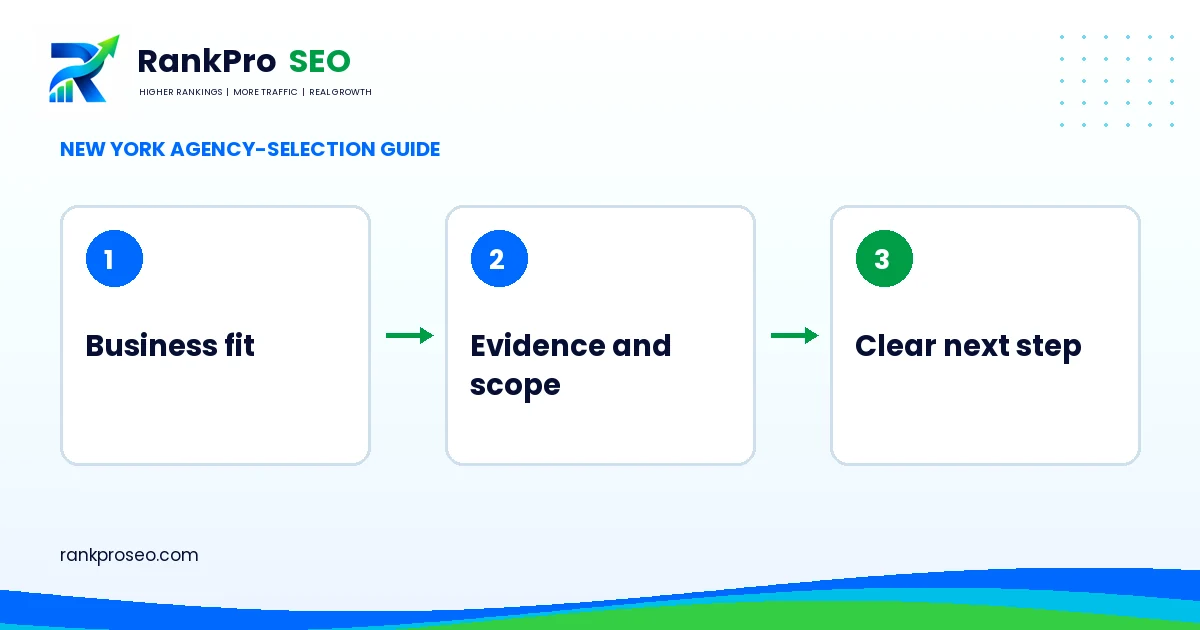
Score each proposal against the same seven checks: business and customer fit; relevant delivery capability; clear scope and exclusions; interpretable evidence; implementation ownership; account and content ownership; reporting tied to suitable inquiries. Record the evidence beside the score and leave unknowns blank. Do not average away a critical gap such as no one being responsible for implementation. Follow up on the unanswered questions before signing an engagement.
Questions when comparing New York SEO companies
Is the biggest agency always the best fit?
Size alone does not establish service fit or attention to your project.
Should I choose the agency ranking first?
Its visibility is one signal to investigate, not proof that its delivery model fits your business.
Does an award prove results?
Check the awarding body, method, date and relevance.
How many proposals should I compare?
Compare enough clearly scoped options to understand the tradeoffs; a long shortlist is less useful when the briefs are inconsistent.
Can a newer agency be suitable?
Evaluate the actual people, method, scope and honest evidence available.
Compare your options against a clear brief
If you are considering RankProSEO, share your website, customer profile and the decision you need help with. Explore the service scope and use the same checklist you apply to every provider.