
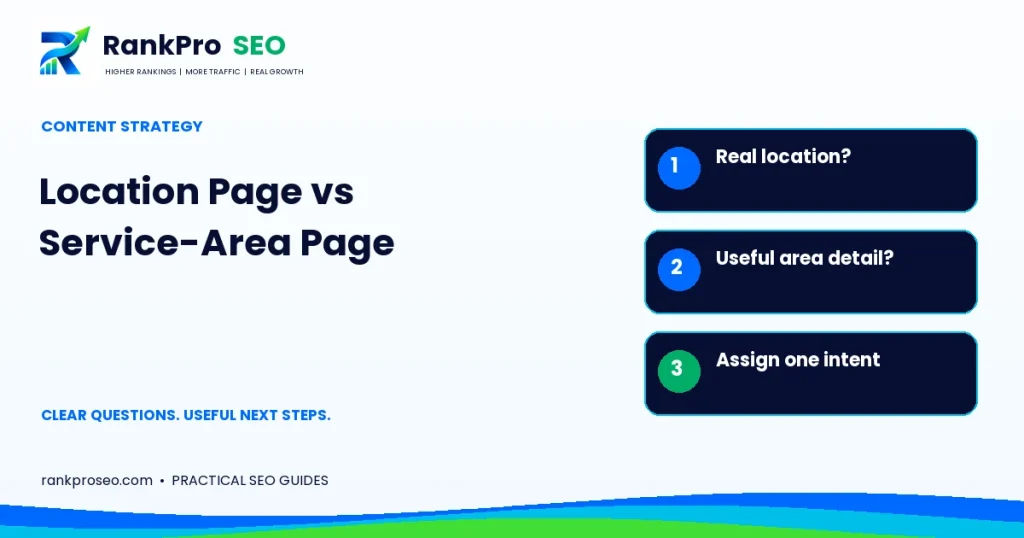
A location page describes a real operating location customers need to understand. A service-area page explains work delivered in an area without implying a branch exists there. Choose the page type from the business reality, then decide whether you have enough useful local information to justify a separate URL.
Location page vs service-area page: the core distinction
A dental office page might include its actual address, appointment arrangements, team, accessibility details and services at that office. A mobile contractor’s area page could explain travel coverage, scheduling constraints and examples of work completed with permission. These answer different customer questions.
Use our multi-location SEO service to explore planning for genuine branches, or local SEO support when the priority is accurate service coverage for one business.
Do not convert a town name into an invented office. A separate landing page is a publishing decision, not proof that a business has a physical location or is eligible for another Business Profile.
What belongs on each page?
| Page type | Useful information | Avoid |
|---|---|---|
| Real location | Accurate contact details, hours, access, available services and local team | Shared boilerplate that hides branch differences |
| Service area | Coverage boundaries, service availability, booking process and genuine area-specific context | A fake address or unsupported arrival promise |
Use a separate-page decision test
Ask whether someone in that area needs a materially different answer. Is availability different? Are there relevant project examples? Does the booking route change? Can you explain local requirements accurately? If all you can change is the city name, improve the broader coverage page instead.
Google’s spam policies warn against doorway pages and substantially similar pages created to funnel searchers elsewhere. A useful area page should be a real destination, with enough information to help the visitor make a decision.
Map services and places before writing
Keep commercial service explanations on their main service URLs. Location pages can summarize availability and link to those explanations. Do not reproduce an entire service page under every town. Maintain a matrix showing which service and geography each URL owns.
For example, one “commercial cleaning” service page can explain scope and quote factors, while a genuine branch page explains the team and scheduling available from that office. Their calls to action can route to the same form without copying the same content.
Common questions
Should every ZIP code have a page?
Only publish a separate page when it provides a distinct, useful answer. Coverage can often be explained more clearly in one place.
Will a canonical tag fix thin city pages?
Canonicalization is not a substitute for deciding whether those pages should exist.
Put the next step into practice
Need help applying this to your website? Explore multi-location SEO services, or request a focused website review. Tell us what you want to improve and which page or process is involved. We will discuss the scope before recommending work.
Continue with the related planning guide for broader context.
Reference: Google: Search spam policies. Practical examples in this article are illustrative, not client results. Platform features and guidance can change.