
How to measure local SEO leads begins with defining a lead your business can actually use. A profile interaction, website visit and booked job are not interchangeable. Build a measurement process that keeps those stages separate, records source evidence honestly and gives the team a useful decision to make at each review.
How to measure local SEO leads: define qualification first
Write a short definition of a suitable inquiry. Include the service requested, the area the business can cover and any genuine fit requirements. For a cleaning company, that could involve the facility type and contract scope. For a professional firm, it could involve the kind of consultation required. Do not collect sensitive details merely because they might be interesting to a report.
Agree which requests are excluded from the qualified total: spam, job applications, sales pitches, duplicate follow-ups and services the business does not offer. Keep the definition consistent through the comparison period. If it changes, record the change so a higher or lower total is not misread as a performance change.
Keep three layers of reporting
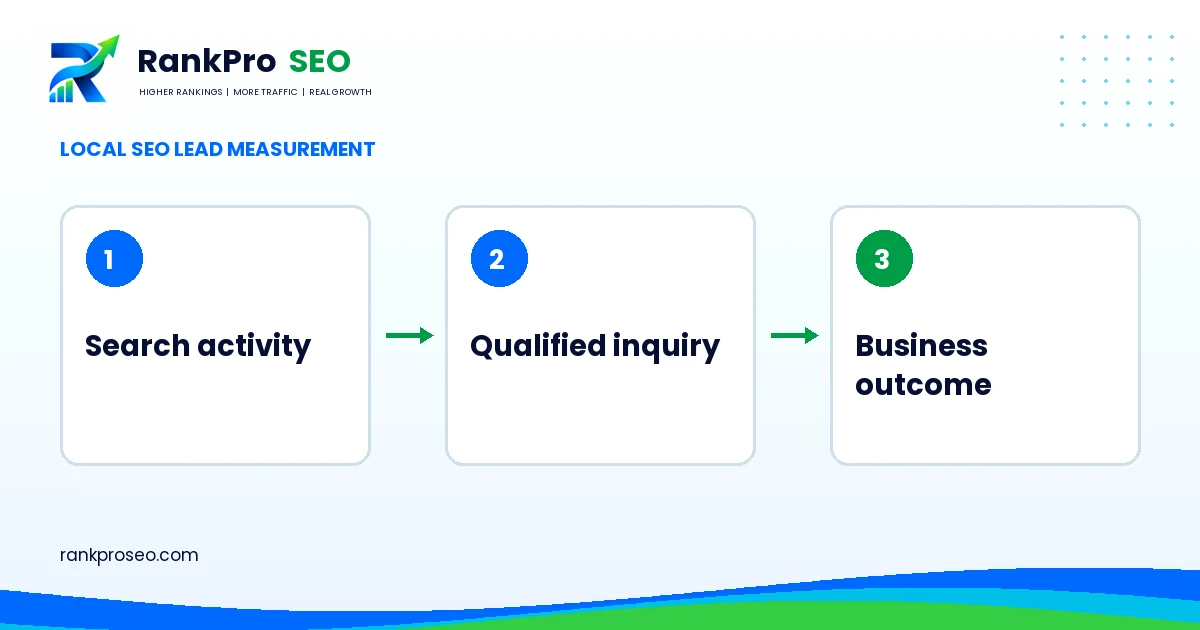
| Layer | Examples | Question it answers |
|---|---|---|
| Discovery | Search impressions, relevant query observations, profile views | Are people encountering the business? |
| Inquiry | Forms, calls, consultation requests | Are people contacting the business? |
| Outcome | Qualified request, proposal, appointment or agreed work | Did the inquiry fit and move forward? |
Business Profile performance reports describe different kinds of interactions. Review the definition of a metric before interpreting it as a customer action. A website click is not a completed inquiry, and an interaction recorded by a platform is not proof of a sale. Use the platform report alongside the website inbox and operational records.
Build a small inquiry log
- Date and a reference number so duplicates can be identified.
- Requested service and broad service area, using only the detail needed for fit.
- Reported source and the evidence supporting it: referral tag, landing page or the prospect’s answer.
- Qualification status, with a short consistent reason.
- Next action and responsible team member.
- Outcome when known, with a date and appropriate uncertainty.
Keep access to the log limited to people who need it. Decide how long records should be retained and how deletion requests will be handled. A useful report does not require copying entire private conversations into a public dashboard. Aggregated counts are often enough for reviewing a service or page.
Test the measurement chain before trusting the chart
Submit a clearly marked test through each form. Verify that it is stored and that the expected person receives a notification. Check the confirmation message and the reply address. On mobile, test the phone link and navigation. If a form stops working after a theme update, the resulting drop in recorded inquiries may have little to do with search demand.
Use an illustrative monthly review
Suppose a website records twelve requests. Four are vendor pitches, three are outside the service area, one repeats an earlier request and four fit the offer. The qualified total is four under that definition, not twelve. If two of those prospects later book work, that is a separate outcome. These numbers are hypothetical and illustrate classification; they are not RankProSEO client results.
Now ask which pages and services attracted the suitable requests. If many visitors ask for a service you do not offer, clarify the copy and review the queries involved. If prospects fit but fail to book, review response time, capacity and the sales process before assuming a ranking problem.
Be explicit about attribution limits
A customer may discover the business in Maps, return through a branded search and submit a form later. Another may copy the website address from an AI answer without a trackable referral. Record what is known and avoid filling the gaps with certainty. Use multiple signals to form a practical view, and keep unknown sources visible rather than assigning every lead to the channel being reported.
Make reporting end with an action
A useful review names the next task, its owner and the check for completion. That might be clarifying a service page, correcting profile hours or improving a form field. Connect the work to the local SEO checklist so activity becomes a maintained process rather than a disconnected set of charts.
Reference: Google Business Profile performance guidance. Practical worksheets and illustrative scenarios in this guide are RankProSEO’s planning recommendations, not published client results.