
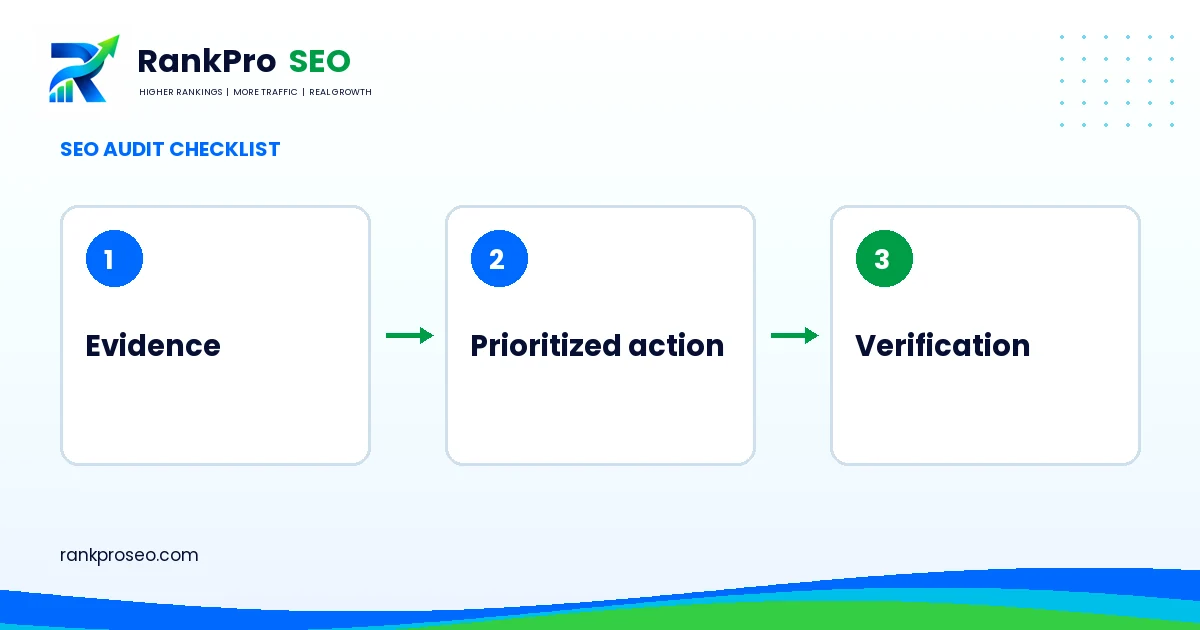
What should an SEO audit include? At minimum, it should explain the important problems found, the evidence behind them and what the team should do next. A report that only lists scores or warnings leaves too many decisions unresolved. This checklist helps you distinguish a useful diagnostic from a long export of tool messages.
What should an SEO audit include before the crawl starts?
Begin with the business and the website’s role. Identify the services, products or locations that matter commercially and the inquiry or purchase actions the site should support. Agree which properties and templates are in scope. Ask what access is available and whether implementation, content changes or follow-up verification are included in the engagement.
For an established website, Search Console can help the reviewer understand observed search activity and indexing information. The tool is evidence for investigation, not a complete explanation of why every page performs as it does. Combine its observations with published-page checks and business context.
Review discovery and indexing
- Can important URLs be reached through useful internal links?
- Do those pages return an appropriate HTTP response and render the expected content?
- Are indexing instructions intentional, including any noindex directives left from staging?
- Do canonical signals and redirects reflect the preferred public destinations?
- Does the sitemap identify the pages you actually want considered for discovery?
Keep these checks separate. A URL in a sitemap can still have a technical problem. A page can be crawlable but intentionally excluded. A canonical points to a preferred representative; it is not a universal remedy for unrelated page overlap. Document the affected URL and the actual observation before suggesting a change.
Review content by intent and template
Inspect representative service, industry, article and conversion pages. Does each page answer a distinct user need? Does the title describe what the visitor will find? Are key claims supported by current business information? Is the next step visible? Review repeated templates because one structural issue can affect many URLs. Do not assume that every page needs a complete rewrite.
Include the customer journey
An audit should test the actions that matter to the business. Submit a clearly marked test inquiry, verify where it is stored and check whether the notification arrives. Review a phone link on mobile. If a service requires a specific location or qualification, check whether the form helps the business assess that fit. Traffic that reaches a broken contact path cannot produce the intended outcome.
Turn observations into a working issue log
| Field | Illustrative entry |
|---|---|
| Finding | A core service page has an unintended noindex directive |
| Evidence | URL, observed directive and dated inspection |
| Business relevance | The page explains a service the company currently sells |
| Action and owner | Website manager removes the unintended directive after approval |
| Verification | Recheck the published response and indexing instructions |
| Follow-up | Monitor discovery and relevant inquiries without promising a ranking gain |
This example illustrates report structure, not an actual client project. A useful issue log also identifies dependencies and exclusions. For example, the SEO reviewer may describe a template change while a separate developer implements it. That boundary should be visible in the proposal and final handover.
Prioritize with evidence and effort
Separate an issue affecting a revenue-critical page from a cosmetic warning on an obsolete URL. Consider the importance of the affected content, how broadly the problem occurs, the confidence in the diagnosis and the effort or risk of the fix. Scores can help organize observations, but they should not replace judgment. Ask why a task comes first and what will establish that it is complete.
Questions before buying an audit
Ask how many templates and properties are covered, whether local profiles are included, how findings are validated and what happens after delivery. Clarify whether a follow-up review is included. If you need implementation help, compare the scope with our technical SEO service rather than assuming fixes are part of every audit.
Reference: Google’s Search Console getting-started guidance. Practical worksheets and illustrative scenarios in this guide are RankProSEO’s planning recommendations, not published client results.