
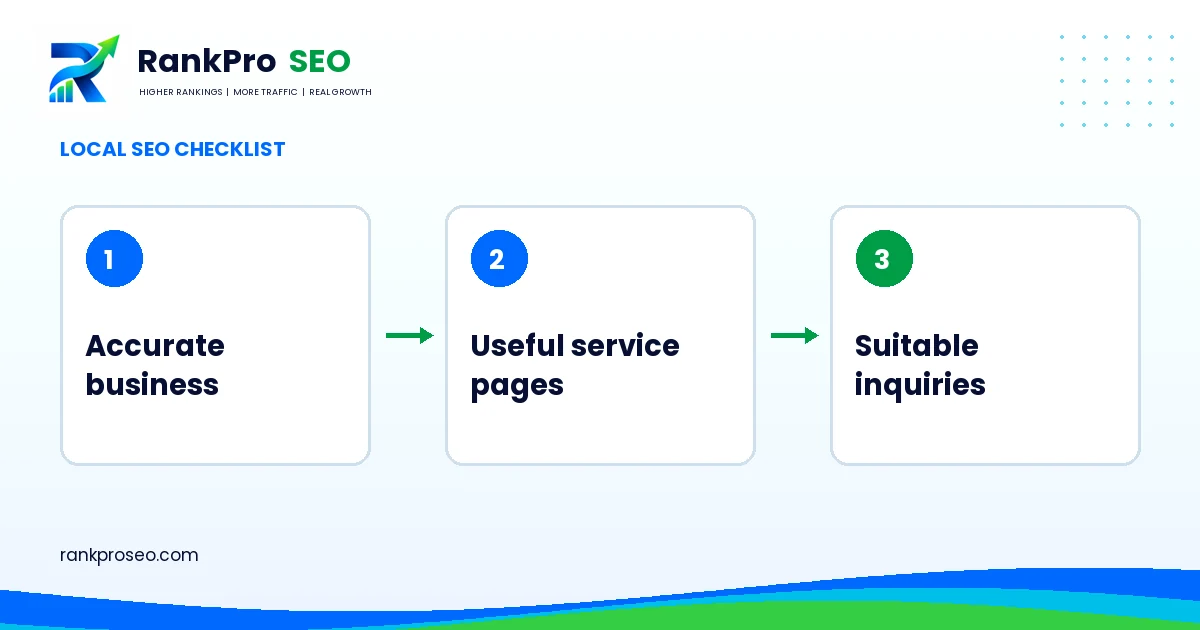
This local SEO checklist for New York businesses connects the information people find in Maps with the decisions they make on your website. Start with accuracy and useful service information, then review the path from search to a suitable inquiry. A checklist helps organize the work; completing it does not guarantee a position in local results.
Local SEO checklist for New York businesses: begin with the real business
Write down the business name customers know, the services you currently provide, the locations you genuinely operate and the areas you can reliably serve. Separate a branch customers can visit from a service area. That distinction affects the information you should publish. Do not create an office claim merely to match a city keyword.
Review your Business Profile using Google’s current eligibility and representation rules. In local ranking guidance, Google identifies relevance, distance and prominence as core considerations. Complete information helps people understand the business, while distance remains a real constraint. Expanding a service-area description does not make the company physically closer to every searcher.
1. Check the profile people actually see
- Confirm the name, phone, website and opening hours. Include genuine special hours when relevant.
- Choose categories that accurately describe the business rather than adding unrelated services for keyword coverage.
- Review services, photos and contact paths for accuracy and current availability.
- Check for an old profile or duplicate listing before creating another one.
- Assign responsibility for reviewing changes and responding to customers.
2. Give each important service a useful website page
A service page should explain the work, the customer it fits, the coverage area, the process and the information needed for an inquiry. Closely related keyword variations can share that page. If two services have meaningfully different customers or requirements, evaluate separate pages rather than placing every offer in one vague paragraph.
For example, a business offering office cleaning and post-construction cleaning may need to explain different scope and quote requirements. That is a reason to review page intent. It is not a reason to generate a separate page for every wording of “cleaning company near me.” Use our keyword overlap workflow before expanding the page count.
3. Make contact details consistent and useful
Compare the website, business profile and important directories. Record incorrect phone numbers, old addresses and duplicate listings. Prioritize sources customers actually encounter and sources relevant to the business. Keep a correction log with the URL, issue, owner, submission date and follow-up status. Bulk directory submission totals are not a useful substitute for accurate details.
4. Treat reviews as customer feedback
Create a routine for responding to genuine feedback and addressing operational issues. Do not invent reviews or publish testimonial claims without permission and evidence. Ask the business to review the current platform rules before designing a review-request process. A strong rating does not remove the need for clear service information or a working website.
5. Test the inquiry journey on a phone
| Check | Pass condition | Owner |
|---|---|---|
| Phone link | Tapping it opens the correct number | Website manager |
| Form | A realistic test reaches the inbox and is recorded | Website manager |
| Service fit | The visitor can tell what is offered and where | Business owner |
| Confirmation | The visitor knows the request was received | Website manager |
| Follow-up | Someone knows who replies and what to ask | Sales or operations |
6. Review qualified inquiries, not just activity
Define a useful lead before comparing reports. A call about a service you do not offer should be counted differently from a quote request you can fulfil. Record enough information to review fit while limiting unnecessary personal data. Compare profile activity, website search signals and inquiry outcomes as different parts of the journey.
Your first review should identify a small number of important corrections, each with an owner and a completion check. Repeat that process as services, hours and business details change. This is more maintainable than publishing a large batch of unreviewed location pages.
Reference: Google Business Profile guidance on local ranking. Practical worksheets and illustrative scenarios in this guide are RankProSEO’s planning recommendations, not published client results.