
How to get your business cited in AI search starts with a limitation: no agency can guarantee that a model will cite or recommend your business. You can improve the clarity, usefulness and accessibility of your public information, then observe what happens. Treat citations, recommendations, referral visits and qualified leads as different outcomes.
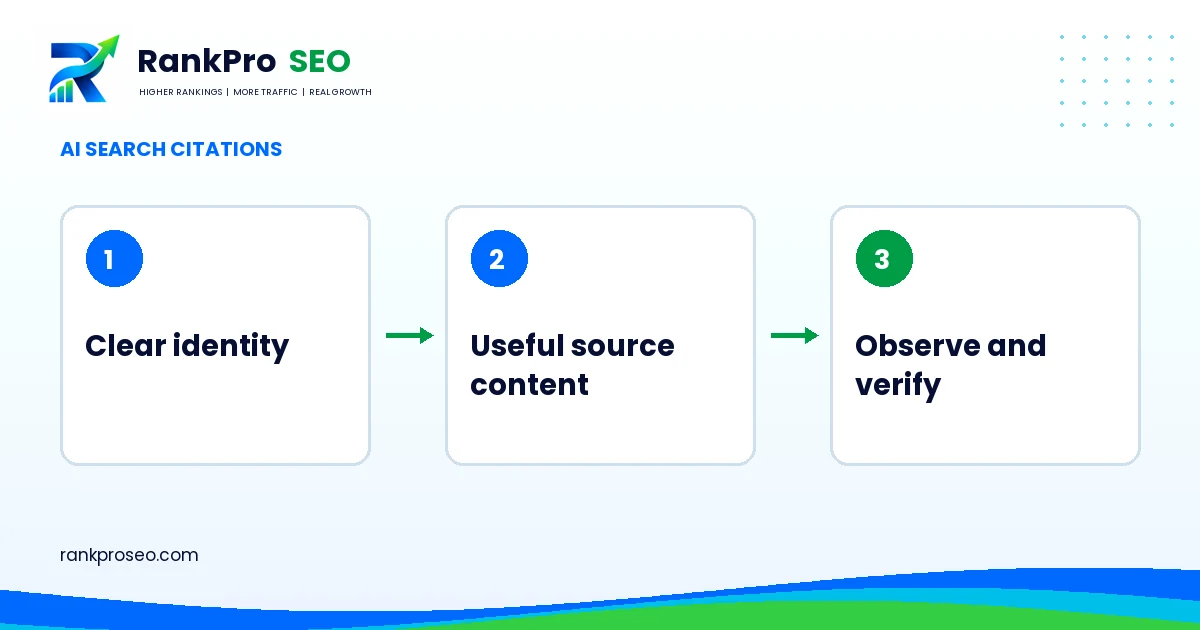
How to get your business cited in AI search: make the business understandable
Publish a consistent business name, a clear description of the services and a reliable contact route. Explain where the business genuinely serves customers without inventing an office. Connect your website to the social profiles the business actually controls. Give each service a distinct page and keep important details current across the sources customers are likely to encounter.
This is an information-quality task, not a repetition exercise. Adding the business name or an entity phrase to every paragraph can make the content harder to read. The page should explain the offer well enough that a buyer can assess fit without guessing what the business does.
Create source material that answers a real question
A useful page may include a comparison framework, an original checklist, a clearly explained process or an example with limitations. Identify what comes from a documented source, what is your recommendation and what is an illustration. When results are discussed, show the evidence and context rather than turning an unverified story into a case study.
- Define specialist terms where they matter to the decision.
- Use headings that make the page’s questions and answers easy to find.
- Explain assumptions and exceptions instead of offering universal claims.
- Name the responsible author or team truthfully. Do not add invented credentials.
- Update facts that depend on a changing platform or product.
Keep established search foundations in place
For Google’s AI search features, its documentation says the established search practices still apply and that no special AI-specific optimization is required. That statement concerns Google’s experiences; it should not be generalized into a guarantee about every other AI product. For your own website, check access, indexing intent, internal links and whether important information is available as text.
Structured data should describe the information actually present. It is not an instruction that forces an AI system to recommend the company. Avoid claims that a special file, schema type or “NLP score” unlocks universal inclusion. Review crawler settings intentionally and understand which service a setting affects before changing it.
Use a citation observation log
| Record | Why it matters |
|---|---|
| Exact prompt and product | Different questions and interfaces can produce different answers |
| Date and relevant location context | Results can change and may vary by context |
| Business mention or source link | A name mention is different from a clickable citation |
| Destination page and wording | Check whether the source actually supports the answer |
| Referral and inquiry evidence | A visible citation does not establish that a lead followed |
Repeat observations consistently enough to compare them, but do not present a small prompt sample as a market-wide visibility score. Save the question and the result context. If a model describes your services incorrectly, first check whether your own pages and public profiles are ambiguous or outdated.
Connect the article to a business action
Imagine a prospective customer asking how to compare local SEO proposals. A guide with a clear checklist can be useful whether the reader finds it through Google, a social link or an AI answer. Its next step should connect to the relevant service rather than demanding a sale before answering the question. Our agency comparison guide demonstrates that educational role.
What should a responsible provider promise?
Look for deliverables the provider can control: accurate business information, useful pages, documented access checks and an observation process. Ask how recommendations are validated and how outcomes will be separated. A report that counts citations without checking the destination, accuracy or business relevance can overstate progress. The objective is a credible discovery path that serves customers across channels.
Reference: Google Search Central guidance on AI features and websites. Practical worksheets and illustrative scenarios in this guide are RankProSEO’s planning recommendations, not published client results.